- Your cart is empty
- Continue Shopping

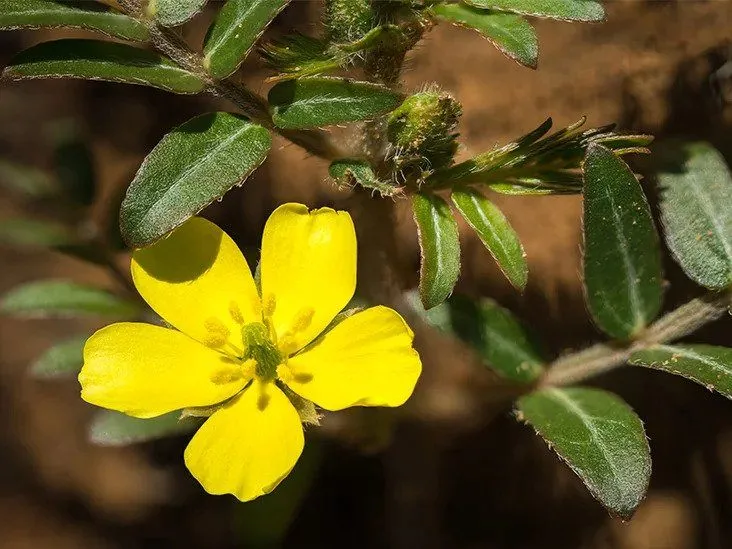
Tribulus terrestris is an annual plant in the Zygophyllaceae family, native to warm temperate and tropical regions across southern Europe, southern Asia, Africa, and northern Australia. The plant is commonly known as puncture vine, goat’s head, or devil’s thorn – names derived from the spiny burrs that cover its fruit, which have a notorious reputation for puncturing bicycle tires and injuring bare feet. Despite its weedy reputation, this hardy plant has been used in traditional medicine systems for thousands of years.
The bioactive constituents of Tribulus terrestris are primarily steroidal saponins, with protodioscin being the most extensively studied and used as a marker for extract standardization. These saponins are found in highest concentration in the fruit and roots of the plant. Other active compounds include flavonoids, alkaloids, and glycosides that contribute to the plant’s overall physiological effects. Standardized extracts typically contain 40–90% total saponins, with protodioscin content varying depending on the plant part used and extraction method.
Traditional uses across major medicine systems include:
Tribulus terrestris has been marketed extensively for its potential role in supporting testosterone levels, libido, and athletic performance. However, the scientific evidence supporting these applications requires careful examination, as results have been mixed and often depend on the population studied and the quality of the extract used.
Research on Tribulus terrestris‘s effects on testosterone has produced inconsistent results. Some studies in animals and in vitro systems have shown that protodioscin may stimulate luteinizing hormone release and support testosterone production. However, well-controlled human trials in healthy young men with normal baseline testosterone levels have generally failed to show significant increases in total or free testosterone. This suggests that Tribulus terrestris may be most beneficial for individuals with suboptimal hormonal status rather than those already within the normal range.
For libido and sexual function, the evidence is somewhat more favorable. A clinical study published in the Journal of Ethnopharmacology found that men with reduced sexual desire experienced improvements in various parameters of sexual well-being after Tribulus terrestris supplementation. The mechanisms may involve increased nitric oxide production and enhanced blood flow to erectile tissue, effects that are independent of direct testosterone stimulation.
Traditional use of Tribulus terrestris for urinary and prostate health finds some support in modern research. The herb appears to have diuretic properties and may support normal urinary flow, making it relevant for men’s wellness formulations that address both vitality and urinary function.
Find more traditional herbs for male strength and stamina in our Ingredient Glossary.
Beyond the debated direct testosterone effects, Tribulus terrestris may influence men’s hormonal health through several ancillary pathways:
Nitric Oxide Synthesis: The herb appears to support nitric oxide synthesis in endothelial cells, promoting vascular relaxation and healthy blood flow. This is relevant to erectile function and overall cardiovascular health, both of which are intimately connected to hormonal vitality.
Endocrine Modulation: Some research suggests that Tribulus terrestris may support healthy prolactin levels and modulate the hypothalamic-pituitary-gonadal axis in ways that promote hormonal balance rather than simply increasing testosterone.
Liver Function and Hormone Metabolism: The saponin content may support liver function, which is essential for proper hormone metabolism. By promoting healthy detoxification pathways, the herb may indirectly support the clearance of excess estrogen and other hormone metabolites, contributing to a more favorable hormonal balance.
While male vitality and hormonal health represent Tribulus terrestris‘s primary applications, research has explored other potential benefits:
| Health Category | Potential Benefit |
|---|---|
| Urinary Tract Health | Diuretic and antispasmodic properties may help maintain normal urinary flow and bladder comfort |
| Cardiovascular Health | Nitric oxide-supporting effects may promote healthy blood vessel tone and circulation |
| Anti-Inflammatory Support | Preliminary research indicates saponins may modulate inflammatory cytokine production |
Tribulus terrestris supplements typically provide 250–750 mg of standardized extract daily, with saponin content standardized to 40–90%. Quality varies considerably across products, as the protodioscin content can differ dramatically depending on the plant source, harvest time, and extraction method. Bulgarian-sourced Tribulus has traditionally been considered the gold standard due to favorable growing conditions that maximize saponin production.
The herb is frequently combined with other male vitality ingredients such as Tongkat Ali, Fenugreek Extract, and D-Aspartic Acid. These combinations address multiple aspects of hormonal health, from hypothalamic signaling to enzyme inhibition to amino acid-mediated steroidogenesis. Tribulus terrestris is also found in some urinary health and general tonic formulations.
Tribulus terrestris is generally well-tolerated, with mild gastrointestinal symptoms being the most commonly reported side effects. Some individuals may experience increased body temperature or restlessness, particularly at higher doses.
Important: Because of its potential effects on blood sugar and blood pressure, individuals taking medications for these conditions should monitor their levels closely when using Tribulus terrestris. The herb may also interact with lithium and certain heart medications due to its diuretic properties.
Individuals exploring Tribulus terrestris may also consider the following complementary ingredients:
| Ingredient | Mechanism | How It Complements Tribulus |
|---|---|---|
| Tongkat Ali | Cortisol reduction and luteinizing hormone enhancement | More robust clinical evidence for testosterone support |
| Fenugreek Extract | Inhibits aromatase and 5-alpha reductase enzymes | Maintains higher free testosterone levels |
| D-Aspartic Acid | Stimulates steroidogenic acute regulatory protein and LH release | Amino acid-based hormonal support |
| Saw Palmetto | Well-researched prostate and urinary benefits | Complements traditional urinary applications |
Neychev, V. K., & Mitev, V. I. (2005). The aphrodisiac herb Tribulus terrestris does not influence the androgen production in young men. Journal of Ethnopharmacology, 101(1–3), 319–323. https://doi.org/10.1016/j.jep.2005.05.017
Rogerson, S., Riches, C. J., Jennings, C., Weatherby, R. P., Meir, R. A., & Marshall-Gradisnik, S. M. (2007). The effect of five weeks of Tribulus terrestris supplementation on muscle strength and body composition during preseason training in elite rugby league players. Journal of Strength and Conditioning Research, 21(2), 348–353. https://doi.org/10.1519/R-18395.1
Gauthaman, K., Ganesan, A. P., & Prasad, R. N. (2003). Sexual effects of puncturevine (Tribulus terrestris) extract (protodioscin): an evaluation using a rat model. Journal of Alternative and Complementary Medicine, 9(2), 257–265. https://doi.org/10.1089/10755530360623374
Adimoelja, A. (2000). Phytochemicals and the breakthrough of traditional herbs in the management of sexual dysfunctions. International Journal of Andrology, 23(Suppl 2), 82–84. https://doi.org/10.1046/j.1365-2605.2000.00019.x
Antonio, J., Uelmen, J., Rodriguez, R., & Earnest, C. (2000). The effects of Tribulus terrestris on body composition and exercise performance in resistance-trained males. International Journal of Sport Nutrition and Exercise Metabolism, 10(2), 208–215. https://doi.org/10.1123/ijsnem.10.2.208
Milasius, K., Dadeliene, R., & Skernevicius, J. (2009). The influence of the Tribulus terrestris extract on the parameters of the functional preparedness and athletes’ organism homeostasis. Fiziolohichnyi Zhurnal, 55(5), 89–96.https://pubmed.ncbi.nlm.nih.gov/20095389/